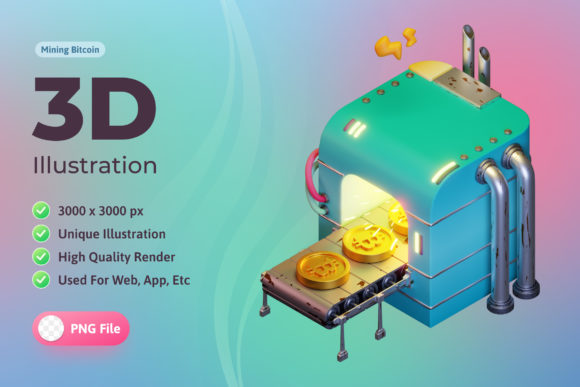
Evaluating 3d Illustration Mining Bitcoin for Modern Digital Projects
The intersection of cryptocurrency culture and digital design has created a unique demand for high-fidelity visual assets. Among the most sought-after resources in this niche is 3d Illustration Mining Bitcoin. This specific visual style combines the technical complexity of blockchain infrastructure with the aesthetic appeal of modern three-dimensional rendering. For designers, developers, and marketers working on projects related to fintech, gaming, or educational platforms, understanding the nuances of these assets is crucial for creating compelling user experiences.
This article explores the practical applications, technical specifications, and strategic value of using 3D-rendered Bitcoin mining illustrations. We will examine how these assets fit into broader UI/UX workflows, compare them to alternative visual styles, and provide guidance on when they are the optimal choice for your project.
Understanding the Visual Language of 3d Illustration Mining Bitcoin
At its core, 3d Illustration Mining Bitcoin refers to photorealistic or stylized three-dimensional representations of cryptocurrency mining processes. Unlike flat vector graphics or two-dimensional line art, these illustrations utilize depth, lighting, shadow, and texture to create a sense of physical presence. Common elements include GPU rigs, circuit boards, glowing coins, server racks, and abstract data streams rendered in metallic or neon finishes.
The distinctiveness of this style lies in its ability to convey complexity. Cryptocurrency is an intangible concept; it exists as code and distributed ledgers. However, the act of "mining" involves tangible hardware and energy consumption. High-quality 3D illustrations bridge this gap by giving form to the invisible. They allow viewers to visualize the computational power and technological sophistication behind blockchain transactions. This makes them particularly effective for explaining technical concepts to non-technical audiences or adding a layer of premium professionalism to financial dashboards.
Technical Specifications and Asset Quality
When evaluating design assets, resolution and format are primary decision factors. Premium collections of 3d Illustration Mining Bitcoin often come with rigorous technical standards that ensure versatility across various media. A key feature to look for is the inclusion of PNG files with transparent backgrounds. This allows designers to overlay the illustration onto any interface element without dealing with unsightly white boxes or complex masking techniques.
Furthermore, the resolution of these assets plays a critical role in their utility. Assets rendered at 3000 x 3000 px offer significant advantages over standard web-resolution images (typically 72 dpi). This high pixel density ensures that the illustrations remain crisp and clear when scaled up for large-format displays, such as hero banners on landing pages, conference backdrops, or print materials like brochures and business cards. It also provides flexibility for future-proofing; as screen densities increase with newer devices, having source material at higher resolutions prevents the need for costly redesigns or re-purchases.
- High-Quality Render: Ensures realistic lighting and material properties, avoiding the "plastic" look common in lower-tier 3D models.
- PNG Format: Facilitates easy integration into design software like Figma, Sketch, or Adobe XD.
- Large Dimensions: 3000 x 3000 px supports both web and print requirements without quality loss.
Comparing 3d Illustration Mining Bitcoin with Alternative Styles
While 3d Illustration Mining Bitcoin offers a premium feel, it is not the only option available for visualizing cryptocurrency topics. Understanding the tradeoffs between different styles helps in selecting the right asset for specific contexts.
3D vs. Flat Vector Design
Flat vector illustrations, often used in modern SaaS interfaces, prioritize clarity and speed of comprehension. They are lightweight, load quickly, and are easily customizable via CSS. In contrast, 3D illustrations are heavier and more static. However, they offer a level of immersion and perceived value that flat designs cannot match. If your goal is to explain a simple step-by-step process, flat vectors may be more appropriate. But if you aim to evoke excitement, trust, or technological awe—such as in a crypto exchange landing page or a gaming app intro—3D assets provide a stronger emotional impact.
3D vs. Photorealism
Photography of actual mining rigs can be authentic but often suffers from clutter, poor lighting, or generic stock imagery fatigue. 3d Illustration Mining Bitcoin allows for idealized scenarios. Designers can control every element: the color palette can match brand guidelines, the angle can highlight specific features, and the composition can be tailored to fit specific layout constraints. This control makes 3D illustrations more versatile for branded content than raw photographs.
Strategic Use Cases and Applications
The versatility of high-resolution 3D assets makes them suitable for a wide range of digital products. Here are some practical scenarios where these illustrations add significant value.
User Interface and User Experience (UI/UX) Design
In mobile apps and web platforms, visual hierarchy is essential. A well-placed 3D illustration can serve as a focal point, drawing attention to key calls-to-action or explaining complex features. For example, a wallet application might use a 3D render of a secured vault or a mining rig to visually reinforce the security and earning potential of the service. These assets help reduce cognitive load by providing intuitive visual metaphors for abstract financial actions.
Web Infographics and Educational Content
Cryptocurrency education often struggles with dry text-heavy explanations. Integrating 3d Illustration Mining Bitcoin into infographics breaks up the monotony and aids retention. When readers see a 3D representation of hash rate or block validation, the concept becomes more concrete. This is particularly useful for blog posts, whitepapers, and tutorial videos where engagement metrics are critical.
Marketing and Brand Identity
For startups and established firms alike, standing out in the crowded fintech space requires strong branding. Custom 3D assets create a unique visual identity that distinguishes a brand from competitors using generic stock photos. The premium nature of high-res 3D renders signals quality and innovation, which can enhance perceived credibility among investors and users.
Decision Factors: When to Choose 3D Assets
Selecting the right visual strategy depends on several factors, including budget, timeline, and target audience. Here is a framework for deciding when 3d Illustration Mining Bitcoin is the right choice.
- Brand Positioning: If your brand aims to be seen as cutting-edge, luxurious, or highly technical, 3D illustrations align well with these values. They suggest investment in quality and attention to detail.
- Platform Requirements: For high-impact visual spaces like homepage hero sections, app splash screens, or promotional banners, the visual weight of 3D assets commands attention. For internal dashboards or data-heavy tables, simpler icons or flat graphics may be more functional.
- Resource Availability: Creating custom 3D illustrations in-house requires specialized skills in Blender, Maya, or Cinema 4D, along with time-consuming rendering processes. Purchasing pre-made, high-quality packs is a cost-effective alternative for teams lacking these resources.
- Performance Constraints: While 3000 x 3000 px PNGs are high quality, they are larger file sizes than SVGs. Ensure that your development team optimizes these assets (using lazy loading or next-gen formats like WebP where supported) to maintain fast page load times.
Limitations and Considerations
No single asset type is perfect. One limitation of 3D illustrations is their static nature. Unlike animated GIFs or Lottie files, standard PNGs do not move. If interactivity is required, designers may need to animate these assets separately or choose video-based alternatives. Additionally, the realism of 3D renders can sometimes feel disconnected from the digital-only nature of cryptocurrency. It is important to balance the physical metaphor with clear textual context so users do not become confused about the underlying technology.
Another consideration is consistency. If a project uses multiple 3D assets, ensuring they share the same lighting direction, color temperature, and artistic style is vital. Mixing low-quality renders with high-end ones can break the illusion of professionalism. Therefore, sourcing assets from a single, cohesive library or commissioning custom work from one artist is recommended.
Conclusion
3d Illustration Mining Bitcoin represents a powerful tool in the modern designer’s arsenal. By combining technical accuracy with aesthetic appeal, these assets help demystify complex financial technologies while elevating the visual quality of digital products. With high-resolution outputs and flexible formats, they offer significant value for UI/UX design, marketing, and educational content.
When evaluating whether to incorporate these illustrations into your project, consider the goals of your brand, the needs of your audience, and the technical constraints of your platform. For projects seeking to convey innovation, security, and premium quality, 3D mining illustrations are a compelling choice. As the digital landscape continues to evolve, the ability to visualize the invisible remains a key advantage, making high-quality 3D assets an indispensable resource for forward-thinking creators.